Bearded dragon care sheet
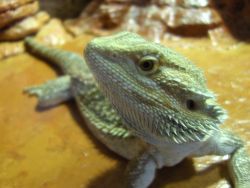
Bearded Dragons are definitely one of the best pet lizards you can own. They are relatively easy to care for, and can have a really nice disposition.
Roughly 90% of them seem to come pre-tamed and seem to have no trouble with handling and light playing. That doesn't mean there aren't a few rough ones in the bunch, but generally all Bearded Dragons react well to them being handled gently with respect. They probably rank second or at least third for best pet lizard for a beginner.
They can grow to a length of 23 inches, but usually wind up in the range of 16 to 22 inches. Be sure to check out the Lizard store for several fun bearded dragon products.
For successful bearded dragon care -be sure and get one that's been bred in captivity, as the ones caught in the wild apparently can be unpredictable and difficult to keep healthy.
Before you purchase a lizard make sure there is a vet in your area that has experience with reptiles. These bearded dragon facts will help you, but a qualified veterinarian will make sure you succeed in giving proper bearded dragon care.
Check out the page on bearded Dragon shedding tips to learn more about how to help your pet bearded Dragon through his shedding process.
Make sure you do the proper research that enables you to make an educated decision on whether or not a pet bearded Dragon is the best pet for you! There are very few reasons why you wouldn't want a beardie compared to a different type of lizard, but you never know -this species may not be for you.
Feeding
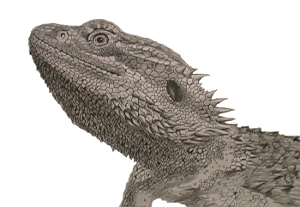
Bearded dragons eat both meat and veggies. As babies they need a lot of protein, but veggies should be offered to them every day. The protein comes in the form of crickets, roaches and some other insects that you need to "plump up" (feed healthy veggies to a day or two before the Dragon eats them) and dust with a multivitamin and calcium powder. (calcium powder -three times a week and the multivitamin twice a week)
It is a common practice to make sure the size of the insect offered should not be bigger than the width of the lizard's mouth. In fact, the insect should be a decent size smaller than the lizard's mouth. I've never cared for a baby beardie, but apparently an abundance (possibly 20 to 50 insects, in this case we'll use crickets) should be offered to a baby bearded Dragon -a day(spread out on two separate feedings). Yes, it can get expensive. In addition to this, fresh veggies should be offered daily, even though your baby bearded dragon might not eat much of the veggies -if any.
After about a year, I slowly moved my pet lizard's diet to primarily fresh veggies with crickets three times a week. As an adult your dragon might tend to prefer the fresh veggies. I also, a few times a year, purchase horn worms or silkworms to give to my adult bearded dragon.
Dandelion greens, mustard greens, collard greens, and turnip greens are all good veggies to offer for proper bearded dragon care.
Lettuce has an extremely low nutritional value,
you probably shouldn't be eating it let alone your pet lizard!
I have not gotten into feeding my bearded dragon anything other than collard greens, dandelion greens, turnip greens and mustard greens -with the protein supplement of crickets or hornworms. Studying these bearded dragon facts might prevent a trip to the vet later.
Water
Providing a water dish is probably not a good idea, it can be a cesspool for bacteria. It also raises the humidity level (which is not healthy for a beardie). If you go with the water dish, you need to change it daily because pet lizards apparently have a lovely habit of defecating in their water dish.
A good way to provide water is to spray mist their salad. You should be giving your pet bearded dragon a bath once a week, your dragon is apt to grab a drink there as well.
Housing
A good bearded dragon habitat should be no smaller than 75 gallons, depending on the size of your bearded dragon. Bearded dragons might tend to be territorial, so housing them together apparently can be a problem. Evidently two female bearded dragons can be housed together, but even then their behavior should be monitored. If one is eating more than the other, or if one seems to be overpowering the other in any way shape or form it's probably a good idea to put them in separate cages. Never put two males together. It's up to you to provide good bearded dragon care so that the stresses of captivity won't take effect on their brain.
Furniture or stuff for your lizard to climb on, engage with, or hide under should be provided. When possible you want to try to combine something to climb up on -and with something to hide under. This saves on floor space. Check out this video that creates a fake rock wall that incorporates something to climb on, a basking spot, and a hiding place. Ideally, for a good bearded dragon habitat you want two hides, one on the hot side -and one on the cold. This allows your pet lizard to regulate its temperature.
As far as a substrate(material or substance on the ground) I've seen everything from newspaper, paper towels or play sand. Sand in general is not encouraged because of the risk of impaction. If your pet lizard, while eating a cricket or a veggie, gets some sand in its mouth -it could consume the sand. This isn't good as the sand could get clogged in the dragon's digestive system.
When discussing bearded dragon facts, this can be a bit of a controversy surrounding the sand issue. The argument for sand comes from the fact that sand is closely related to a bearded dragon's natural substrate -apparently that of loose dirt. The reality is a bearded dragon in the wild doesn't have a great chance of living beyond one year. The odds are stacked against him, and I would bet it's safe to say that impaction probably plays a role in a wild dragon's longevity.
If you have to have sand in your bearded dragons habitat then put sand on just one side of the cage. Put the dragon's salad dish on the side -without sand, and feed him crickets in a separate container.
As far as cleaning the cage, I "poop" my dragon every other day; that is to say I give him a warm bath in the hopes that he will poop in his bath and not on his fake rock structure. If he does happen to poop on his fake rock furniture -I use a mixture of half water and half White vinegar -in a water bottle, combined with scrubbing with paper towels. I let this air out before putting the bearded dragon back in the cage.
Lighting
For proper bearded dragon care, you need a heat light plus a UVB light. I use a mercury vapor bulb, as this is apparently the closest mimic of the sun available. A lot of people say they experience a different pet lizard with a mercury vapor bulb. A healthier pet lizard with more energy and life.
The mercury vapor bulb also emits heat of which your lizard needs to digest its food. If you don't get a mercury vapor bulb you'll need to add a second light fixture to supply the heat.
Either way you'll want the light fixtures to be ceramic-based.
You need to provide a basking spot for your pet lizard. This spot needs to be in the range of 100° to 110°. You need to get a thermometer to make sure your temps are accurate, I use a temp gun.
The cooler side of the cage needs to be roughly 75° to 85°. Put the light or lights on an inexpensive automatic timer. Have them on for 12 to 14 hours.
You want your pet lizard to be exposed to the UVB light and heat for at least an hour before you feed him. This will apparently allow him to better be able to digest his food.
Proper lighting and temperatures also contribute to a bearded dragon's ability to shed its skin.
Check out the page on
bearded Dragon shedding tips to learn more about how to help your pet bearded Dragon through his shedding process.
Brumation
Of all the bearded dragon facts -Brumation is the most difficult to accept and understand. It's the Reptile equivalent of hibernation. Every beardie might be slightly different when it comes to Brumation. Some will sleep for up to five months at a time, and I've heard of other bearded dragons not brumating at all. One factor might be -how long your bearded dragon's blood line has been in captivity.
Other factors might be -the humidity level. Or your bearded dragon could choose to do whatever he or she wants!
An adult beardie(juveniles should not brumate or be encouraged to brumate-they evidently need their protein) will usually start to slow down around October.
The basking light should be maintained as normal(the UVB light) because if your beardie wakes up and decides to eat (you should provide a little food during Brumation) he will need the light to be able to digest his food.
Some people lower the temps to around 72°(room temperature) to simulate the seasonal change.
If you happen to notice your beardie eating during Brumation, it might be a good idea to occasionally put him on the basking spot to encourage good digestion.
As with any care sheet with any pet lizard(or any other animal) it's always a good idea to read several different care sheets to learn as much as possible so your pet lizard can be healthy and happy.
This is of course true with providing excellent bearded Dragon care. Seek out more care sheets and bearded dragon facts to enable you to provide the best possible care for your pet lizard.
All information given from experience from caring for these creatures, and open dialogue from the internet.
Share your bearded dragon care tips or stories!
Do you have some helpful or fun stories that could aid a fellow bearded Dragon owner?
What Other Visitors Have Said
Click below to see contributions from other visitors to this page...
Care and food 
My bearded dragon has shown quite an interest in dandelion greens. If you live in the country or even the suburbs, then honestly all you have to do is …
Am I over reacting?
My Beardie isn't really eating since I changed his surroundings... I got him a month ago with sand , dome rock, wood perch and a mirror as background. …
my bearded dragon turned orange
Well I went downstairs and my little bearded dragon was orange so I tapped gently on the glass and he did not respond like he does, what does this mean? …
Help new to caring for bearded dragon
So bought a baby bearded dragon from pet co. They didn't tell me how to care for him. Nor did they give me a care sheet. He's only about five inches long. …
Help
We'll my problem is that it's my first time being a bearded dragon owner.. And we'll I purchased a juvenile a month ago and he's been doing well until …
Scared
I got my beadie like month ago. He's really skinny and he dosent eat his pellets. Im reay scared cus idk if hes sick or he dosent like the pellets idk. …
Lazy baby Beardie named Maxi
Just got a baby Beardie that is about 5 months I think. He does not eat much and is too lazy to chase crickets. He ate a few meal worms from his dish …
maureen j
I have a wild bearded dragon living in the bushes beside my flat. He lives at the end of a bridge in the rocks and bushes. I throw raw steak, cooked pork, …
sand sucks
I had a leopard gecko and I realized he was eating his sand. I thougt it was healthy because petco's care sheet said leaperd geckos eat it to help digest …
I'm very worried about my baby bearded dragon
I have a 10 month old baby bearded dragon, I used to have 4 older ones too, she came from one of my older ones so I have had her since she was born and …
my beardie is ill...
My bearded has been neglected by previous owners and the result of that is he is very skinny, dont hardly move and he dont eat bugger all. I understand …
Bearded Dragon Rescued From Death
Hello, my name is Sarah, i'm almost 18 and this is the story of how I rescued my Beardie.
I was in California in the summer of 2010, I was staying …
Bearded Dragon cage furniture
My family gave me a Bearded Dragon when I was a child. This Bearded Dragon, named Thor, was a really friendly pet. He did have one little problem when …
Bearded dragons bonding with child
My Kid and His Two Bearded Dragon Lizards. We have two Bearded Dragon Lizards; Draco and Drago. I wonder why some people are scared of them, as they are …
Jealous bearded Dragon
Jealous Bearded Dragon I have had Rasta, my baby bearded Dragon for a year and a half. He is very jealous, and I did not know that was possible. At first …
beardie sleeping all the time 
Our adult female beardie is not waking up unless we wake her up by a bath. We don't know what to do 😞 her breathing is good normal her skin is normal …
My bearded dragon is very inactive and we are SOoo in love with him!
We just recently acquired a bearded dragon. It was gift and am completely uneducated about caring for a reptile. I have many questions all suggestions …
Help Not rated yet
I don't know what your name is but I want to assure you everything is alright.take your bearded dragon to a vet just to make sure. If nothing is wrong …
My lizard ate my other lizard Not rated yet
It all started when me and my mom were on the way to Sunny Side. Me and my mom were going to sunny side to get pumpkins, apples, apple cider, and donuts. …
My bearded Dragon Freaked out Not rated yet
I have a 10 month old bearded dragon named Cookie, my 4 year old named him, I have never had any issues with him. We got him when he was maybe a month …
New to beardies Not rated yet
I recently went to work for our local pet store and fell in love with the beardies (as we call them). The one that was there when I started was a fairly …
beardies Not rated yet
I would recommend buying them at pet smart and but the bearded dragon starter kit that is the cheapest way to go! I got one and she is soooooo sweet! I …
baby bearded dragon realy shy ? Not rated yet
I just got a baby bearded dragon yesterday from my friend because he is a breeder and the lizard is 4 months old but ever since I have had him he has been …
Beardie Too Small??? Not rated yet
I have a male bearded dragon named Raptor he is 1 year and almost 4 months old. I don't know if its bad but he is only 7 1/2 inches long nose to tail, …
mixing bearded dragons.. Not rated yet
If I already have a beared dragon but, want another. Would it be a okay if I were to put the new one in the others cage?
Response:
I would advise …
the nice but mean beardie Not rated yet
Yy beardie Omega is nice to me but jumps out of everybody elses hand. I'm worried he might hurt his little head and his sand in his tank is dirty and every …
confused Not rated yet
I got my beardie (Bruce) about 6 months ago. He is only 7in. Is that normal? Also the pet store told me to put sand in when he gets 8-9in. Is this a popular …
baby beardie sleep! Not rated yet
I recently bought a baby beardie. Shes amazing but we always had trouble with her sleeping. She refused to adjust to a normal sleep schedule. She would …
rocko on a sicko Not rated yet
Paul, my mums boyfriend got a beardie -her name was lola she was 3 monthes old and then I wanted one, I got rocko who lola was bought from, we took him …
I have 2 bearded dragons Not rated yet
Ok so I bought 2 baby bearded dragons one is active all the time but eats very little and is a bit smaller, the other is fater and lazy but eats a lot …
Bearded Dragon Facts and Information Not rated yet
Bearded dragons are the probably the best pet lizards you can own. Bearded dragons are animals that come from Australia or Africa.
FEEDING …
My first bearded dragon Not rated yet
My first bearded dragon was about 7 inches. After a while I got another -about 12 inches long. Every night it sleeps with me for about two hours. After …
my new bearded drsgon spike Not rated yet
A week ago i got a bearded dragon that the owner could no longer look after. She told me that she had not been able to feed him for about two weeks -no …
Out the rump on to the floor! Not rated yet
I figured out the hard way that bearded dragons should not be let to run around house right after a huge meal
(he/she will leave you a suprise.)
7 month old bearded dragon Not rated yet
When I got my bearded dragon zilla when he was 2 weeks old. It was my first reptile I have ever owned and I was a little scared that I was going to do …
bearded dragon food Not rated yet
My bearded dragon is 11 monthes old he spends most of his time in his cave. When it comes to feedin I give him crickets but every so often I try him with …
Emily Not rated yet
We recently had a bearded dragon amd called him fluffy, i've been reading up on them and spoken to the breader now i feel ive got mixed information, he …
The Story About My Bearded Dragon Not rated yet
This is the story about my bearded draon. She is very funny and hiper, and she loves to eat crickets -but she hates mealworms. Whenever i try to pick …
bearded dragon diet Not rated yet
hello, I just adopted a juvenile beardie from one of my friends a few weeks ago. I had no idea how to keep care of a beardie, so I started reading books, …
Concerned Beardie Mommy Not rated yet
I have a one year old beardie and Rodney is the love of my life. This is the first hybernation I am experiencing and I'm concerned. Rodney has stopped …
dont be afraid of your dragon Not rated yet
If your afraid of your Beardie you will most definately have problems training him/her... If so try to get as use to him/her and interact as much as you …
Great first reptile! Not rated yet
My first reptiles were a pair of bearded dragons and they have been great starter reptiles. I find them very rewarding and although they can take a bit …
My cute little Draco Not rated yet
I have had Draco for about six weeks now, amd weve kind of bonded. He loves to be out, falling asleep on my shoulder, my neck, anywhere he feels safe. …
Puff our dragon and his feeding Not rated yet
He is great, I got him on craigslist for 100 dollars with everything tank, hiding place. Anyways the guy who had him for eight months, or since he was …
The Escape Not rated yet
I put my bearded dragon out in my back yard in a fenced cage. He climed the cage and jumped on to my trampoline and ran across it and jumped off the other …
The World's most Famous Dragon- "Sunny" Corleone Not rated yet
I went to Whitie's Pet Store in Fresno one night before going to the Gym, NOT intending to buy a pet, but just for like a little fun "field trip" like …
recess for bearded dragons Not rated yet
I own two bearded dragons. appa and azula. i got these names from the show "avatar the last airbender". i love that show. anyways. i have their tanks by …
Mr. Lizzy the bearded dragon... Not rated yet
I got my beardie when he was about eight months old. He lived a horrible life until I rescued him. He was tortured from other beardies just like him …
bearded dragon bonding Not rated yet
When my son said he wanted to keep a lizard as his pet, I was shocked. I never thought he would ask something as such. Why a lizard? But then his friend …
Lost bearded dragon Not rated yet
When Draco got Lost -My bearded dragon, Draco, once slipped away from his basket, when we where on our way
to a camping. We realized it only when we …
dragons for pets! Not rated yet
We bought new bearded dragons for our house. My children want to have bearded dragons as a pet in the house. So we bought these bearded dragons. The sales …
Bearded Dragon assignment Not rated yet
Today I am going to tell you the story of my lizard. I am from zoology and that?s why I was involved in a project concerning reptiles. I did deep study …
Bearded Dragon bathing Not rated yet
This is the time I gave my bearded dragon his first bath. I recently had read that I am supposed to give my bearded dragon a bath once a month. I filled …
Bearded Dragon advice Not rated yet
The "Lizard" is a four legged reptile of SQUAMATA order.
Everyday we are aware of the species of reptiles around
us. It may be a snake reptile, lizard …
Bearded Dragon cage issues Not rated yet
My family gave me a Bearded Dragon when I was a child. This Bearded Dragon, named Thor, was a really friendly pet. He did have one little problem when …
Overcrowded bearded dragons Not rated yet
We have three bearded dragons and we love all of them,
although one of them is a little "slow". Lilly chases our
other girl Bonny around the tank thinking …
Bearded Dragon -not interested in brumation (hibernation). Not rated yet
Well, it's interesting, my bearded Dragon decided to have a very short brumation this past winter. He went to sleep his usual time which was around late …


